 Content Analyst at Investors Clinic
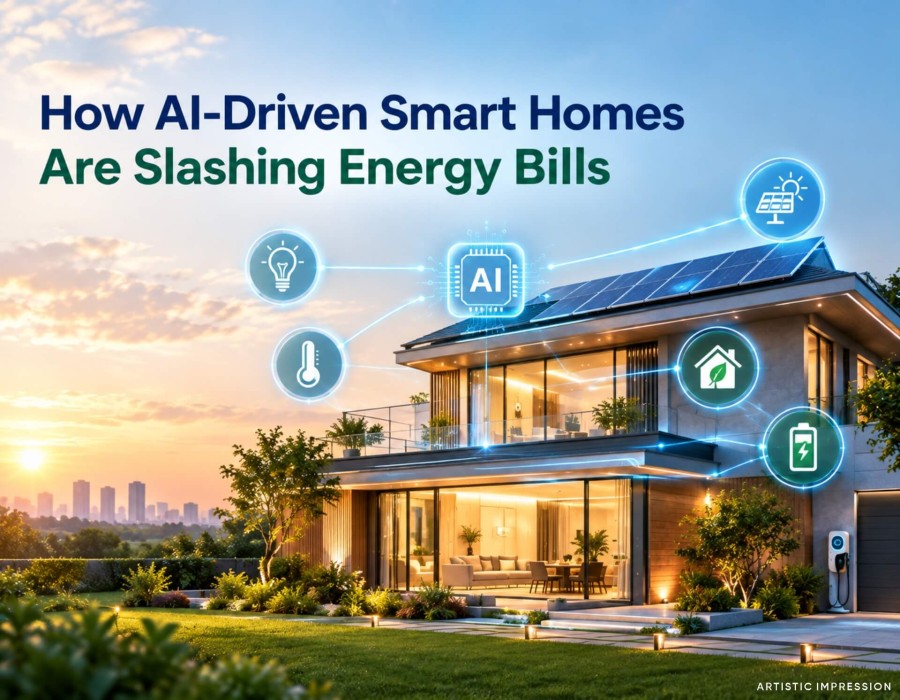
Today, a modern home is more than a place to live. Now, it is becoming an intelligent ecosystem called smart home automation that uses connected devices, sensors, and artificial intelligence (AI) and uses real-time data to optimize power consumption in lighting, cooling, appliances, and the provision of security.
Such energy efficiency reduces recurring property costs and increases long-term appeal that homebuyers, IT professionals, and real estate investors prefer most in today’s energy-efficient world.
In what ways is AI making homes energy efficient?
Traditionally, our homes rely on manual control for occupancy, temperature, usage patterns, and electricity consumption, which leads to major mistakes, mismanagement, errors, and poor performance metrics. AI-driven systems tirelessly, intelligently, and continuously analyze these to automate decisions, save energy, and boost efficiency.
Examples are
-
Smart thermostat:
Regulation of cooling according to occupancy and weather conditions.
-
Automatic lighting:
Switching off lighting when nobody is present and controlling lighting levels.
-
Smart appliances:
Use of power-intensive appliances during optimum times.
-
Monitoring of energy consumption:
Real-time energy consumption monitoring and identifying energy losses.
-
Routine settings via AI:
Learning household behaviors and setting optimized parameters.
It is more about creating a smart house than interconnecting devices.
A Journey towards AI-Driven Living from the Existing System of Home Automation
This era of home automation enables you to operate your home appliances, lights, curtains, or security systems remotely. These systems need your attention and precision, but now the future is blossoming with AI-driven home automation systems that empower homeowners with complete peace of mind through 100% automation without the hassle of alarming disruptions. This is how an existing system of home automation is being replaced by AI.
For instance, sensors will be able to sense when a room is unoccupied and change its temperature settings without the need for any manual intervention.
|
Feature |
Traditional House |
AI-Enabled Smart Home |
|
Lighting |
Manual |
Occupancy-based |
|
Cooling |
Constant/Manual |
Adaptive |
|
Energy Monitoring |
Limited |
In Real Time |
|
Appliance control |
Manual |
Automatic |
|
Optimization |
User-driven |
AI-assisted |
Things That Bring Advantages to Real Estate for Smart Home Automation
The overall value proposition of the property is broadly calculated based on energy efficiency. Today’s buyers are becoming smarter and updating their selection based on operating costs, convenience, sustainability, and technology infrastructure beyond square footage.
The best home automation systems in India are designed around interoperability, mobile control, sensors, security, and energy management instead of isolated smart devices.
It helps differentiate the property in the market for investors. For end-users, reduced energy wastage is one way of ensuring consistent utility bills.
Related Blog: https://investorsclinic.in/blog/smart-homes-vs-traditional-homes
Model of Home Automation Project: What It Should Contain
A modern, practical home automation project model should include the following:
- Occupancy and environmental sensors.
- Lighting and climate control intelligence.
- Systems for energy monitoring.
- Networked appliances.
- Control by a central system or app.
- AI-powered automation schedules.
- Secure connections and privacy protections.
The motto of AI-driven homes is not to automate everything, i.e., to automate the areas where measurable convenience and efficiency are observed when using technology.
The Future of AI Homes: It's Predictive, Not Reactive
The future of smart home automation focuses on predictive energy management through AI that can potentially anticipate household patterns, integrate weather information, and then coordinate devices instead of independent control.
For those who need solutions to smart home automation near me, scalability, security, interoperability, and compatibility with the property's infrastructure should be the key considerations.
Why This Is Important for 2026 Buyers
- Less energy wasted
- More day-to-day convenience
- Greater insight into usage
- Increased technological appeal
- Possibly improved property distinction
Conclusion
The luxury lifestyle in India’s real estate is enjoying a holistic use of AI, transforming the smart home from a collection of connected gadgets into an intelligent energy-management ecosystem that is slashing the cost of energy, boosting sustainability, and synergizing the adoption of technology. Such things keep influencing residential decision-making. Thus, smart home automation can become the next turning point in the real estate sector.
Are you looking for an AI-enabled smart home property? Explore Investors Clinic’s curated inventories designed for modern living