 Content Analyst at Investors Clinic
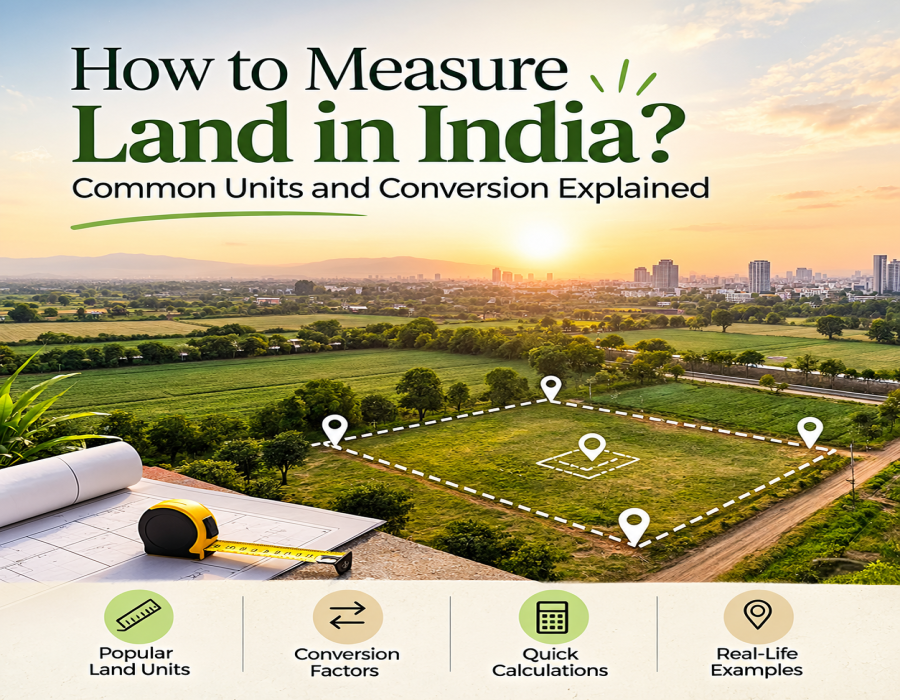
If you have two plots of land, one being 200 square yards and the other being 1800 sq ft, are these two sizes different? No, they are both the same size.
However, if you are buying a plot that is listed as being a certain amount of bigha, biswa, or kanal, would you know?
Understanding how to measure land in India is very important when buying residential plots, assessing property prices, and checking property documents. Due to there being different traditional methods in each state of India, knowing what measurements equal how much can help you to make an informed decision.
In this guide, we will talk you through some of the most common land measurements used in India, the formulas to convert them, differences between regions, and some calculations.
Why is it important to measure land in India?
It is important to know how to measure land because this is how you will be able to get the precise measurement of your land. It is through knowing this measurement that you will be able to evaluate Residential plots in India and find out how much value your money can buy.
For instance, if a residential land plot sells at ₹15,000 per square yard, measuring your plot will help you calculate the cost of the land.
Measurements of land are particularly significant when buying agricultural land, residential plots, and properties in various states.
Common Units of Measuring Land In India
In India, there are global units of measurement, as well as traditional units. The most popular are square feet and yards for smaller plots, and for larger lands, acres and hectares.
The following is an example of units of measurement for land in India:
|
Unit Of Measure |
Equivalent Area |
|
1 Square Foot (sq ft) |
0.1111 square yard |
|
1 Square Yard (sq yd / Gaj) |
9 square feet |
|
1 Square Metre (sq m) |
10.7639 square feet |
|
1 Acre |
43,560 square feet |
|
1 Acre |
4,840 square yards |
|
1 Acre |
4,046.86 square metres |
|
1 Hectare |
10,000 square metres |
|
1 Hectare |
2.47105 acres |
|
1 Kanal |
20 Marla (where this convention applies) |
|
1 Marla |
1/20 Kanal (where this convention applies) |
[Source: Government of India, Ministry of Agriculture & Farmers Welfare, “Agricultural Statistics at a glance 2024-25” Conversion Table]
This makes it easier to compare the size of a property.
Traditional Units Of Land Measured by State: Land Measurement Chart
Traditional units of measure like Bigha, Biswa, and Katha do not have an exact conversion as they can vary from state to state. They can vary depending on the local revenue system, too.
According to the Government of India metadata and data standards document, there are many traditional units of measure:
|
Region |
Traditional Unit |
Documented Area |
|
Assam |
1 Bigha |
2,880 sq ft |
|
Assam |
1 Katha |
720 sq ft |
|
Rajasthan |
1 Bigha (Shahjahani Jarib) |
27,225 sq ft |
|
Rajasthan |
1 Bigha (Gantari Jarib) |
17,424 sq ft |
|
Jharkhand |
1 Katha |
~720 sq ft |
|
Haryana |
1 Kanal |
20 Marla, under the specified settlement convention |
Other traditional land measurement units in India include
- Biswa/Biswansi—Traditional sub-units of Bigha found in North India.
- Kanal/Marla— Common in Haryana, Punjab, Himachal Pradesh, and Jammu & Kashmir.
- Lessa— Found in Assam and other Northeastern regions.
- Guntha— Found in some regions of Maharashtra, Karnataka, and Andhra Pradesh.
- Cent— Common in Kerala and Tamil Nadu.
- Dismil/Decimal—Found in some regions of Eastern India.
Important Note: These are examples provided in documentation; they are not legally defined. For example, Haryana has its own data standards specifying different karam and settlement systems. Always check local revenue records to ensure the correct conversion rate is used for traditional units of measure.
Reference: Government of India – Metadata and Data Standards, Annexure: Land Measurement Units and Conversion Factors.
Important Formulas for Land Measurement Conversion
Understanding basic conversions will make measuring land easier.
|
Conversion Requirement |
Formula |
|
Square feet to square yards |
Sq ft ÷ 9 |
|
Square yards to square feet |
Sq yd × 9 |
|
Square feet to square meters |
Sq ft × 0.092903 |
|
Square meters to square feet |
Sq m × 10.7639 |
|
Square feet to acres |
Sq ft ÷ 43,560 |
|
Acres to square feet |
Acres × 43,560 |
|
Acres to hectares |
Acres × 0.404686 |
|
Hectares to acres |
Hectares × 2.47105 |
These are standard conversions. With traditional units, the correct conversion factor for your region must be used.
Reference: National Institute of Standards and Technology (NIST) – SI Units: Area
How Dimensions Help Calculate Land Area
If you have a rectangular or square plot, then working out the area is easy.
Formula: Area of Land = Length * Width
Make sure that both length and width are in the same units.
A Practical Method to Find the Size of Your Residential Plot
Example 1:
Residential Plot Size in Square Feet
Your residential plot size is:
- Length: 60 ft.
- Width: 40 ft.
Total Area = 60 * 40 = 2,400 sq. ft.
Converting into square yards:
2,400/9 = 266.67 sq. yd.
Example 2:
Residential Plot Size In Square Yards
- Your plot size is 30ft x 45 ft.
Total Area = 30 * 45 = 1,350 sq. ft
Converting into square yards:
1,350/9 = 150 sq. yd. (Gaj).
This will help you compare residential properties.
If your plot is odd-shaped, you may need to break the land up into smaller shapes or have a professional measure it.
Working with a Land Measurement Calculator.
A land measurement calculator will help convert land area from one unit of measure to another.
You will need to:
- Enter the land area.
- Select the Original Measurement Unit
- Choose the unit of measure you would like to convert to.
- Review the result.
This will give you the converted area. For instance, when you input 1,800 sq ft and select to convert to sq yd, you will get 200 sq yd.
But the calculator only converts the figures without verifying whether you own the land plot, its boundaries, the measurements, and official documents. In case you want to convert into bigha, biswa, and other such units, then the calculator should have the appropriate conversion ratio for that particular area.
Things To Check When Buying Residential Plots
Although knowing the land area is necessary, here are a few things to be taken care of while purchasing residential plots, i.e., a property buying checklist:
- Area As Shown On Paper—Verify if the area shown on the paper is similar to the one mentioned on the sale deed, allotment papers, and all other revenue papers.
- Size of Plot—Verify the length, breadth, and boundary details with those of the sanctioned layout.
- Official Land Papers—Verify ownership, survey/khasra number, land parcel details, and all other relevant land records. In case you are in Uttar Pradesh, the UP Bhulekh website will help you check khatauni and all other land records.
- Sanctioned Plot Plan – Check the plot number, size, and usage according to the sanctioned plot plan.
- Land Surveyor – If there are any irregularities, get the assistance of a land surveyor. Consult revenue authorities.
- Check Title—Just because you know the area doesn’t mean you own it! Check the title chain, relevant approvals, encumbrances, and any other documents with a qualified professional.
Common Mistakes While Buying Land That Buyers Should Avoid.
Even experienced people can make common mistakes when comparing land areas. Common errors made are as follows:
- Believing 1 Bigha is the same throughout India.
- Mixing up Square Feet and Square Yards.
- Not converting the price of plots.
- Not checking if the dimensions listed match the actual size.
- Using conversions in approximate form from the internet.
- Assuming that the land area calculator determines ownership or the boundary line.
It would be safe to go by the usual conversions used in the standard units and test the traditional units with the revenue records.
Conclusion
In all, being able to measure your land forms a significant aspect of property. Whether you are seeking to purchase residential plots, compare residential properties, or look for property in Gurgaon and other Delhi NCR areas, it will be easier to determine the value of the land once you are familiar with its size.
At Investors Clinic, we understand that making sound choices involves being aware and knowledgeable. It will thus become much easier for you to make a choice by measuring the land and confirming your documents.`
Do not base your property decision on mere figures. Always ensure that your decision-making is based on facts. Partner your decision with the best real estate consultant in India.
References:
The following references can be consulted by readers looking to understand standards for measuring land and cross-verifying property-related information.
- Ministry of Agriculture and Farmers Welfare, Government of India: Agricultural Statistics at a Glance 2024-25. Standard Conversion of Area.
- Government of India: API Setu - Metadata and Data Standards. Land Measurement Unit and Conversion Factor. Traditional Conversion of Land Measurement Units.
- Ministry of Statistics and Programme Implementation: Agricultural Statistics Manual. Conversion Factors for Local Land Measurement Units.
- National Institute of Standards and Technology: SI Units. Area. Metric Measurement of Area in Hectares.
- Government of Uttar Pradesh: UP Bhulekh Portal. UP Land Records.
Remember: The rate of conversion of the standard unit of measuring the area of land may vary from one State, district, or revenue settlement to another. It is always advisable to cross-check the rate of conversion with the relevant authorities before carrying out any transaction involving land.